
Ten Chinese Consumer Trends: Report
Consumption is charging ahead in China with all social classes and age groups increasingly combining online and physical platforms to maximize accessibility and convenience. This is the conclusion of Consumption Trends China 2013, a joint survey and analysis by MEC, a major international media agency and CIC, a leading social business intelligence provider in China.
The study identified 10 major trends that are likely to shape Chinese consumption for years to come. Most interesting among them are Chinese concerns about food and product safety, emerging ‘highbrow’, ‘nostalgic’, and hedonistic tastes, spending by and catering to singles and the ‘gray-haired’, along with charity and altruistic pursuits.
Here is Part I of a two-part summary:
Consumer safety scandals involving tainted food and faulty products are upper most in the minds of consumers, prompting many to “pay for safety” – paying premium prices for organic foods, buying property and auto insurance, and posting microblogs on food and road safety. Last summer, CCTV’s hugely popular A Bite of China documentary on Chinese food culture engendered a revival in regional cuisine but also evoked memories of when food was simple, natural, and safe. The series inadvertently spawned sarcastic remarks on microblogs about the state of food safety in China.
In addition, websites like www.zzcw.info (throw it out of the window) organized by a group of volunteers in 2011 provide information on poisonous and harmful foodstuff reports going back to 2004. On May 3, a couple weeks before the airing of A Bite of China, the site crashed temporarily because it was getting too much traffic, revealing the extent of concern at the grassroots.
In part due to the food scare, middle class consumers are renting plots in the suburbs to grow their own food. Happy Farm, a micro-farming website, lets subscribers rent a small plot to grow their favorite vegetables and fruits. Renters tend to the plots themselves or have the farm manager and his team help out. Netizens experience firsthand harvesting the fruits of their labour or they can ask the farm to harvest and deliver the produce. The remarkable thing is that growth of their vegetables can be monitored online.
Chinese consumers also desire more culture in their improving lives. They like the arts, gourmet food and travel, and are eager to show off their “cultured life” on social media. The ‘foodie’ phenomenon has infected Chinese consumers even more severely than in the West, especially given the depth of Chinese food culture. Sitting at a table with scrumptious dishes, instead of gobbling them up straight away, the first impulse is to pull out mobile phones and take pictures to send to friends or post on weibo. Many Chinese foodies have accumulated large portfolios that are shown to like-minded fans around the world.
What used to be haute culture is now more accessible to the general public. Consumer spending on highbrow cultural events and performances has grown steadily over the past few years and not confined to the large cities, attested by rising expenditures in tier 3 and 4 cities. And providers have been quick to catch the wave. Since the end of 2011, for example, the Shanghai Grand Theatre has made each third Sunday a month a discount ticket day for diverse and multi-genre performances. Two rounds of discount ticket sales at the beginning of 2012 attracted long queues of enthusiasts. Similar programs have been introduced in Beijing and other major centers.
On the Internet, sites catering to “backpackers” and “tour pals“ are another expression of the Chinese craving for developing “cultural temperament”. Travelling is as much about culture and people as it is about scenery. On weibo, there are legions of netizens following the corporate accounts of travel agencies and hotels. For those who like to record their experiences in artistic ways, picture-taking is a favourite medium. Not counting smart phone picture takers, aficionados carry single-lens reflex (SLR) cameras with them wherever they go. Within a couple years, household ownership of SLRs has gone from 10% to 14% in 2012 and the proliferation of photo sharing platforms encourages even more people to participate.
The institution of marriage is not as sacred as it used to be as China’s population of single men and women increases year by year. The “singles culture” and “singles effect” is a much-talked about topic on microblogs. Singles are unburdened by family responsibilities and are by definition hedonists willing to open their wallets for immediate gratification. Compared to other groups, they go to the cinema more often with a date, with friends or on his/her own. Cooking for one, singles tend to frequent nearly convenient stores rather than busing or driving to supermarkets for major grocery shopping. Products and services specifically designed for singles are thus on the up and up.
In China, like traditional Valentine’s Day for couples, singles have their own Singles’ Day (November 11). Chinese numerology considers 11-11-11 the most auspicious Singles’ Day of the century. Last year, Taobao.com launched a campaign offering free delivery and 50% discounts on many famous brands. The resulting turnover reached 960 million RMB, setting a record for B to C e-commerce. Revenues this year topped a whopping US$3 billion, double Cyber Monday revenues in the US that ComScore estimated had hit $1.5 bn. Black Friday, November 23rd, barely passed the $1 bn mark.
Discussions centering on keywords “retro” and “nostalgia” have been surging on weibo. In 2012, tweets involving “retro” grew 10-fold to 22,588,671. Retro is the new fashion in which consumers find deep emotional resonance. Scribbled Warrior Shoes and sailor’s stripe shirts, all the rage in the sixties and seventies that combine retro and modern elements are back in vogue. ‘Educated Youth’ canteens targeting students who were sent down to the countryside during the 1960s and 1970s and “post-70” and “post-80” (people born in the 1970s and 1980s) restaurants draw crowds reminiscent about the innocence of youth. In the hustle and bustle of the daily grind, dining on era dishes in a setting surrounded by memorabilia, people cannot but be overcome by nostalgia and a longing for simpler times.
Statscan: China Among Top Ten Travel Destinations for Canadians
Canadians travel frequently but when it comes to knowing where we went and where we’re going, it’s not rocket science. In fact, dozens of organizations conduct surveys on the subject. But like on election day, when voting is the only poll that matters, the only surveys that provide a comprehensive snapshot of our actual cross-border movements are the ones done by Statistics Canada.
Statscan knows when — and how — we leave the country, where we go, how long we stay, when we return, and approximately how much money we spend while we’re away.
And while complete statistics for 2012 won’t be released until next year, and I can’t rank the Top 10 destinations with 100% certainty, I am pretty confident we have, and will, remain true to form in where we went and where we will go in 2013. As a nation, we are quite loyal and our Top 10 foreign destinations have not changed much in the past decade. Barring war, political upheaval or major natural disasters in those places, they likely won’t change much in 2013 either.
The United States will remain No. 1. It was No. 1 when our dollar was worth 65¢ US, and now that the loony is on par, almost par, or above par, the number of trips south of the border has soared to some 20-million-plus per year.
Our top states, are — predictably — border states and sunshine states: New York, Florida, Washington, California and Michigan in that order. Visits to New York, Washington and Michigan tend to be one to three-days, while visits to California and especially Florida are much longer.
As for the rest of the places on our Top 10 list, sometimes their rankings change but the destinations themselves remain pretty much the same.
Sun destinations continue to be wildly popular with Mexico, Cuba and the Dominican Republic being Canadians’ fave places to hit the beach.
These are accented by our favourite European destinations — the United Kingdom (always in the top five, even when the British pound is much higher than it is now), France, Italy, Germany and the Netherlands.
China is our preferred Asian destination, and the only country from that part of the world to make into the Top 10.
– canoe.ca/Travel
South to North Water Diversion to Begin This Year
Water pressures are growing in China and this is the beginning of alleviation efforts for the parched north.

Global Times Poll: 80% of Respondents Say China Not Yet a World Power
Bilateral relations with the US, Japan, and Russia are the top three influential relationships for China, according to a survey released Sunday by Global Times’ Global Poll Center. More than half the respondents had a positive view of Sino-US relations, though many agreed that the US pivot toward Asia and its efforts at strategic containment of China are holding relations back.
The survey indicated the Chinese people have a dimmer view of Sino-Japanese relations, as nearly 70 percent of those surveyed chose Japan’s so-called nationalization of the Diaoyu Islands as the most significant global event in 2012.
The survey, conducted through phone calls and the Internet, collected responses from 1,404 residents above 15 years old and from seven Chinese cities, including Beijing, Shanghai, Guangzhou and Changsha.
According to previous Global Times surveys over the past seven years, Sino-US relations have been considered the most influential bilateral relations for China, with 74.6 percent of the respondents agreeing this year, although its significance has seen a noticeable decrease from 2010 to 2012. Around 34 percent of the respondents think Sino-US relations have become tenser during US President Barack Obama’s term over the past four years.
Some 53 percent of the respondents think positively of Sino-US relations despite agreeing that certain issues, such as the US containment of China, business and trade frictions, the Taiwan question and disputes on yuan exchange rates, have been affecting relations.
The report showed that most of the respondents had pessimistic expectations of Sino-Japanese relations, with less than 24 percent expecting an improved relationship. Some 38 percent thought the relationship would stay as it is now, and another 33 percent believed it would get worse.
While some 38 percent surveyed remain optimistic on China’s surrounding environment, more than half still think disputes over the South China Sea and US involvement in the issue are affecting China’s relations with ASEAN countries.
Despite all the pressure and frictions China faces, some 81 percent of the respondents said the country will have a favorable international environment for its future development, while some 57 percent expect the country to encounter growing friction in the process.
China is not yet a global power to over 80 percent of the respondents, although many agree that the country has got what it takes to become one in regard to economic and military development.
Around 57 percent chose China as their “favorite country.” The US was listed as the second best country and the most desirable country for those wishing for an experience abroad.
China’s Settlement of Land Border Disputes
In the backdrop of China’s ongoing disputes with its neighbours over islands in the East China and South China seas, some in the Western, Japanese and Southeast Asian press have been hammering China over its supposed ‘bullying’ and ‘trampling’ non-sovereign territory. A previous post traced the Diaoyu Islands dispute to the First Sino-Japanese War and outright annexation of the islands by Japan. This post seeks to dispel the notion that present disputes taint China as an expansionist power.
During the more than 60-year reign of Emperor Qianlong (1735-1799), the Qing Empire reached the pinnacle of territorial expansion, encompassing Manchuria, Mongolia, Xinjiang, Tibet, and Taiwan. The Qing Empire was much larger than the Han and Tang dynasties and arguably even bigger than the mighty Yuan Dynasty under Kublai Khan. Territorial expansion largely occurred under the rule of non-indigenous rulers such as the Mongols and Manchus. The borders of present day People’s Republic largely follow that of the Qing, less Mongolia.
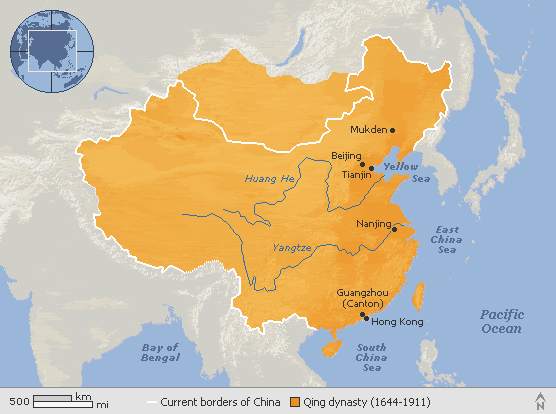
Due to “unequal treaties”, the weak late Qing emperors lost much territory to the Russian Tsar, ceding what is now the Russian far east and parts of Xinjiang in the far west. When the Communists took power in 1949, it inherited a total of 23 territorial disputes, mostly with states along its contiguous land borders including most importantly the Soviet Union and India.
In 1962, a one-month border war was fought between China and India resulting in the latter’s utter defeat that still resonates loudly in the Indian national psyche. In 1969, border clashes broke out between the Chinese and the Soviets over Zhenbao (Damanskii) Island on the Ussuri River that defined part of the northeast border, a dispute that was later resolved with Russia in the 1990s and 2000s. In 1979, China launched an equally brief attack across the northern borders of Vietnam as reprisal against Vietnam’s invasion of Kampuchea (Cambodia). Vietnam was seen by the Chinese as a surrogate for the Soviet Union in expanding throughout Indochina.
Soon after the implosion of the Soviet Union, China commenced negotiations with several Central Asian Republics – Tajikistan, Kazakhstan, and Kyrgystan – and Russia; continued marathon deliberations with the Indians; and moved to repair relations with Vietnam. By the late 2000s, China had settled all land border disputes save those with India and tiny Bhutan. In 17 disputes, points out M Taylor Fravel, a security expert at MIT, China offered significant concessions to accept “less than half of the territory being disputed”.
Srikanth Kondapalli, a China scholar at New Delhi’s Jawaharlal Nehru University, grudgingly agrees: “Whether China actually gave up territory or made a substantial concession is a debatable question (but China overall) has been liberal in border dispute resolution”. (Both scholars were cited in January 2011 Asia Times article “China Plays Long Game on Border Disputes” by Bangalore based journalist Sudha Ramachandran.)
China’s border negotiations with India have been the most vexing. A 1959 diplomatic note sent by Chinese Premier Zhou Enlai recognized a Line of Actual Control (LAC) that includes a section of the McMahon Line. A year later, he offered a swap to the Indian government: recognition of India’s sovereignty over territory south of McMahon Line in the eastern sector in exchange for recognition of China’s sovereignty over Aksai Chin in the western sector. But, this olive branch was summarily rejected. In 1981, paramount leader Deng Xiaoping offered a similar “package settlement” but eight rounds of talks proved futile.
On a state visit to China in 1988, Indian Prime Minister Rajiv Gandhi agreed to a joint working group on boundary issues but that too made little progress. Neither did a 1993 agreement to define the LAC. Three years later, both sides agreed to set up “confidence-building measures” to avoid border clashes. Although sporadic incidents have occurred along the McMahon Line to the present day, disagreements have been confined to within a kilometer of the LAC.
As for the settlement of the remaining six territorial disputes both on land (with India) and at sea (with Japan, Vietnam, Philippines, Malaysia, and Brunei), journalist Ramachandran suggests that China is now less likely to extend concessions to settle them but the possibility for the use of force is low. However, the role of the US in backing the Japanese on the Diaoyus and a closer military relationship between the US and India could become destabilizing factors.