
UBC President: Canadian Education Must Tilt to Asia
Canadian think-tanks have been working overtime these days churning out reports about the necessity for Canada to mesh much closer with emerging economies, especially China and other East and South Asian countries. The latest contribution comes from Stephen Toope, President of UBC, in his advocacy to turn education into a major pillar of Canadian foreign policy and economic growth strategy.
Strengthening Education and Research Connectivity Between Canada and Asia, written for the Canadian Council of Chief Executives (CCCE) (see last post on a similar CCCE education related report), bashed Canadian governments for their ‘episodic and sporadic’ initiatives; their ‘diffuse’ efforts at working together; and inability to scale up programs to achieve the scale necessary to yield ‘truly transformative results’.
Mr Toope called for strong branding of Canadian educational excellence in targeting key Asian markets such as China and India that represent half of the top ten source countries for international students to Canada. China has been a primary source for many years running, having sent close to 1/4 of the nearly 100,000 foreign undergraduate and graduate students in 2009. Another 12% come collectively from India, South Korea, Japan, and Hong Kong.
In 2010, the number of long-term Chinese students at all levels ballooned to nearly 57,000, cited an earlier report prepared by Roslyn Kunin & Associates (RKA) for Trade Minister Ed Fast. That year, foreign students contributed more than CAN$6.9 billion to the Canadian economy with Chinese and South Korean students taking up some 37% of that. In terms of percentage of imports of Canadian goods and services to their country, Chinese consumption of Canadian educational services accounted for nearly 14%. Rates were even higher for South Korea, India, and Saudi Arabia.
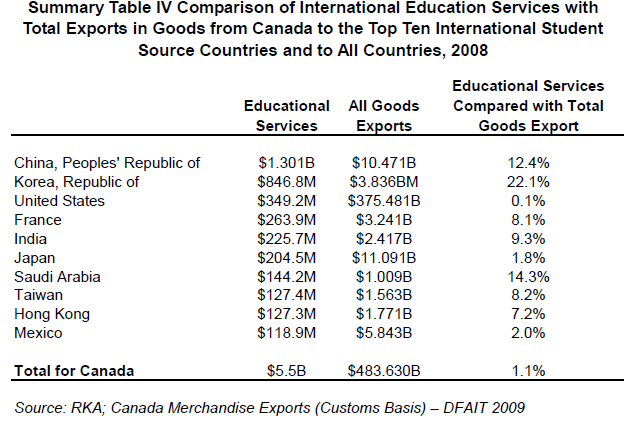
Citing Australian and New Zealand moves to eliminate differential tuition fees for foreign graduate and post-doctoral students in a bid to attract more talent to their universities, the RKA report encourages Canadian educational authorities to do likewise. Foreign students in Canada pay two to six times more than local students to attend college or university.
“Given the competition in the global international education market, educational policy makers may need to re-examine the practice of differential tuitions and fees”, the report declared.
In his paper, President Toope added that the Canadian government should ramp up its high-profile Vanier Canada Graduate Scholarships and Banting Postdoctoral Fellowships to attract and retain world-class international talent. On top of that, vigorous scholarship programs for undergraduates should be created, working with the private sector and higher education institutions.
In this connection, last May, BC Premier Christy Clark announced a $5 million scholarship and internship program under a broader plan to boost the number of foreign students attending BC schools by 50% – 47,000 more students – within four years. Almost half of that target is expected to attend private language schools with the remainder going to public and private high schools and K-12 schools.
Mr Toope complained about the lack of interest among Canadian students to study overseas for credit as a reflection of persistent provincialist attitudes and lack of government commitment. Germany, he pointed out, has actively promoted international study for undergraduates, devoting millions to fund study-abroad scholarships, resulting in almost 1/3 of all German students going abroad for part of their education. Further, he urges the integration of international elements, especially Asian content, into domestic programs from kindergarden through university. In particular, there should be a strong emphasis on promoting Asian language study in Canadian schools.
The UBC President also wants to see more effort on the part of Canadian universities to work with host institutions to develop full offshore programs including distance learning, export of Canadian curricula, franchising courses and programs, and provision of various education services abroad. UBC’s Sauder School of Business, for instance, already offers more than 30 programs in China and Canada for senior government officials and business executives. To date, UBC has trained more than 500 senior leaders from across China.
Cognizant of the epochal shift in the center of science and technology R&D toward Asia, President Toope suggested that closer collaboration with Asian research institutions would help stimulate Canadian research and economic competitiveness. Over the years, China’s R&D budget has risen dramatically. In February, China’s National Bureau of Statistics in its annual statistics report disclosed that R&D spending in 2011 had surged 21.9% to US$139.7 billion, representing 1.83% of GDP, on course to reach the target of 2%.
Canadian government policy of late has been heartening nonetheless, wrote Mr Toope. In addition to key MOUs signed with India and important missions to Vietnam, Singapore, and Malaysia in 2010-11, this year, Prime Minister Harper and Chinese President Hu Jintao announced that Canada and China aim at increasing the two-way exchange of students to 100,000 within five years.
“Canada’s universities are often at the forefront of engagement with developing economies. As such, they are an asset that both government and the private sector can work to advance our place in the world. By working together, we can ensure that Canada’s economy and society will thrive and prosper”, he concluded.