
Study: Canada Needs More STEM Graduates to Compete
A recent report commissioned by the Canadian Council of chief Executives (CCCE) draws a grim picture of Canadian higher education that it is failing to graduate a new generation of scientists and engineers. If downward trends persist, Canada’s ability to compete in the rapidly evolving global economy could be threatened.
Competing in the 21st Century Skills Race (Competing) compares Canadian and Chinese achievements in general literacy, student enrollment in science, technology, engineering, and mathematics (STEM), and cultivation of skills for innovation. It is co-authored by Graham Orpwood, York University professor emeritus of mathematics, Bonnie Schmidt, president and founder of Let’s Talk Science, a non-profit NGO, and Hu Jun, associate professor at the China National Institute for Educational Sciences in Beijing.
Canadian education has traditionally set high standards for literacy and the OECD Program for International Student Assessment (PISA) consistently places Canadian teenagers among the top in reading, mathematics, and science. In 2010, the Conference Board of Canada gave Canadian primary and secondary education highest marks, surpassed only by Finland among 17 peer countries. Canada also scored high in high school and college completion rates.
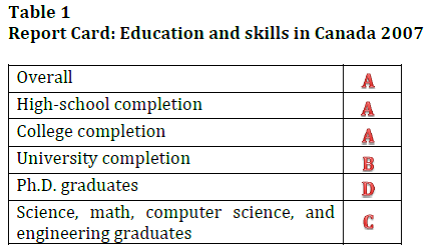 source: Conference Board of Canada
Canada falters, however, in post-secondary STEM education. A benchmark study on Canadian science learning sponsored by Let’s Talk Science and Amgen, a leading Canadian biotech company, found that from 2004 to 2007 only 10-13% of university degrees granted were in the sciences. What’s worse, engineering degrees constituted a mere 8-9% of all degrees granted. By contrast, the proportion of engineering graduates in China had increased from 30% to 37% in the same period.
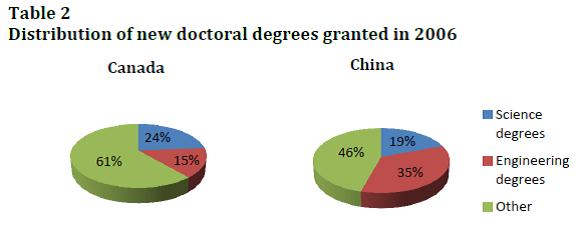 source: OECD Science, Technology and Industry Scoreboard
The situation doesn’t improve at the doctoral level. In a 2006 ranking, science and engineering doctorates accounted for only 22% and 17% respectively of all doctorates. Again, China trained far more engineering and science doctorates – 37% in engineering and 20% in the sciences.
In terms of student preferences, a 2010 Angus Reid survey of teenage Canadian attitudes found only 37% interested in taking a science course at university. Competing similarly found a majority of Canadian students not attracted to STEM programs and careers. The Amgen/Let’s Talk Sciences study points to a serious disconnect between positive perceptions of the importance of science in society and young people’s desire to pursue as a science or engineering career.
Looking at labour market trends, Competing concludes that Canada faces a growing shortage of skilled workers with STEM university or post-graduate degrees. It cites a 2010 study by Dr Rick Miner, President Emeritus of Seneca College, projecting that in Ontario alone, there will be a million skilled vacancies by 2021 and close to two million by 2031. (already 1/2 million vacancies in 2011) Human Resources and Skills Development Canada says most vacancies are in mining, IT, transportation equipment, oil and gas, science services, and health care, all sectors requiring solid STEM educations.
The challenge for Canadian post-secondary education, then, is fostering interest in STEM programs and encouraging young people to take up STEM careers. Posing a few ‘awkward questions’, Competing strongly suggests the creation of a National Roundtable on Skills with the participation of various levels of government, the private sector, NGOs, and educators.
A rethinking of subject boundaries and development of multi-disciplinary education is needed to recruit and retain young people in STEM programs. With the help of the private sector, better linkages must be made between educational programs and career paths.
For these reasons among others, the report recommends robust and long-term academic exchanges and collaboration between Canada and China to enable deeper understanding and exploration of innovative trends in education. It would also help Canadians better understand China as a world-class developer of skilled workers. This is all the more important given that China is expected to provide 30% of the world’s high-skilled workforce by 2030. (see post of June 11, 2012)