
Qianhai Bay and RMB Internationalization
Shenzhen is expected to experience another burst of hyper growth with the establishment of its Qianhai Bay economic zone, a ‘mini-Hong Kong’ hub for deepening financial reform. Starting next year and gradually over eight years, Qianhai’s barren reclaimed lands will be transformed at a cost of 285 billion RMB (US$44.8 billion) into an ultra-modern zone specializing in financial, logistics, and IT services.
Hong Kong based banks will be able to lend money to companies based there who enjoy low taxes, a more rigorous legal structure, and more stringent anti-corruption measures modeled after Hong Kong. Zhang Jianmin, vice-chairman of the National Development and Reform Commission (NDRC), China’s top economic planning agency, described the future zone as a pioneer for close collaboration between Hong Kong and the mainland for the gradual opening up of China’s capital account and full convertibility of the RMB.
Prior to the announcement, FinanceAsia magazine conducted a poll of 276 investment and commercial bankers, along with corporate executives and investors, mostly based in Hong Kong, on prospects for the internationalization of the RMB. About 30% of respondents believed the RMB will be freely convertible by 2020, coinciding with the completion of the Qianhai zone.
Speaking to the magazine, Yongmei Cai, a partner at Simmons & Simmons in Beijing, commented: “The acceleration of RMB liberalization in the past several years is remarkable…If this pace continues, and the erosion of obstacles to capital flows back to China…we may well see China’s economy fully integrated with the global and regional economy in a decade”.
Tim Cordon, chief Asia economist for ING bank added: “Were internationalization to lead to capital account convertibility, it would be the most significant pro-market economic reform since China acceded to the WTO in 2001. From what we have seen, I expect the RMB to become fully convertible in 5 to 10 years from 20 years as previously expected.”
While most (42%) said it could take at least until 2025 with 24% arguing it would take even longer, FinanceAsia wrote that the speed of RMB liberalization reform to date has been ‘lightening fast’. Below are the results of the survey on how much trade will be settled in RMB and when:
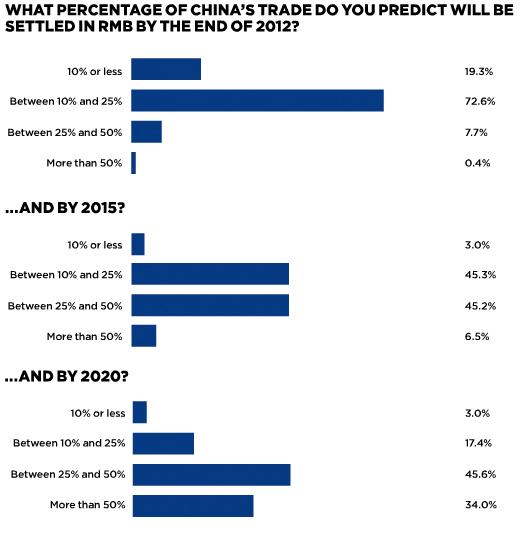
80% of those polled pointed to restrictions on the capital account as the single biggest obstacle against free convertibility. They urged the authorities to speed up capital account reforms and reforms to the country’s political system. For investors, full liberalization of the RMB means diversification of portfolios, more direct exposure to China, and closer integration of Chinese capital with global capital markets.
FinanceAsia notes that reforms have been gathering pace since the early 2000s, particularly over the past 4 years. In 2009, the authorities launched the RMB trade settlement scheme in Hong Kong which has been expanded. Bilateral RMB swap agreements have been signed with 14 trade partners and pilot schemes for inward and outward foreign direct investment (FDI) were introduced. In addition, the qualified foreign institutional investor program (QFII) has been expanded from US$30 billion to $80 billion.
In 2011, capital markets grew by “leaps and bounds” with dim sum (RMB denominated) bonds near tripling 2010 levels to $14 billion. 2/3 of the respondents expected to see steady increases this year to $15 to $20 billion with 18% even more bullish, predicting the bonds could expand two fold. Total issuance for the offshore RMB market (including certificates of deposit and dim sum bonds) was $26 billion last year. Most respondents expect amounts to remain in the $25 to $50 billion range over the next three years but may exceed $50 billion by 2020.
As for key international trading centers for offshore RMB outside of Hong Kong, a majority of respondents (52%) felt that less than 5% of global offshore RMB market will be handled in London, Singapore, and New York this year but 48% thought that by the end of the decade, 20% to 50% will be covered by these them. Meanwhile in Hong Kong, at the end of last year, RMB deposits reached 588 billion, 10% of all, displacing deposits in US dollars and euros.