
Nuances of Chinese Censorship
Official censorship is certainly a controversial issue in China but how extensive is it, what sort of issues are monitored, and what actions taken have rarely been discussed in the foreign press. But the title of a recent report from researchers at Harvard’s Institute for Quantitative Social Science – How Censorship in China Allows Government Criticism but Silences Collection Action – speaks much about the Chinese authorities’ approach to Internet censorship.
Although Chinese censors are able to delete content with ‘military precision’, they do so in nuanced ways that often run counter to blanket condemnations. The authors argue that contrary to conventional research and analysis, “the purpose of (China’s) censorship is not to suppress criticism of the state or the Party…we find that when the Chinese people write scathing criticism of their government and its leaders, the probability that their post will be censored does not increase. Instead, we find that the purpose of the censorship program is to reduce the probability of collective action by clipping social ties…”
In contrast to common perceptions in the West, the authorities have allowed (and even encouraged) the expansion of social media, permitting sufficient room for negative commentary about the government, its policies, and its leaders. Negative criticism may make Chinese politicians look bad but that in itself doesn’t alarm them. Chinese individuals are essentially free to express their grievances so long as their potential capacity for collective action is eliminated.
In fact, rather than stifling comment on China’s many social media, officials saw them as excellent avenues to gauge citizen sentiment on any number of public issues, their interaction with government departments, and their perceptions of public officials’ performance. Social media can be turned around and used by the government to find ways to “satisfy and ultimately mollify” citizens. The ‘surprising’ patterns the authors discovered points to a “theoretically optimal strategy” adopted by the government.
The study also sheds light on relations between the central, provincial, and local governments, and on China’s relations with the outside world. Often times, local governments can act autonomously of the national government on specific issues that reveal the priorities of the localities as opposed to the center. Here the oft-quoted Chinese adage is apt: “the mountains are high and the emperor is far away”.
During the first half of 2011, 85 topic areas were sampled fitting into three levels of hypothesized political sensitivity. Posts were monitored from 1,382 Chinese websites, with the biggest being Sina Weibo, (59% of all samples), hi-baidu, voc, bbs.m4, and Tianya.
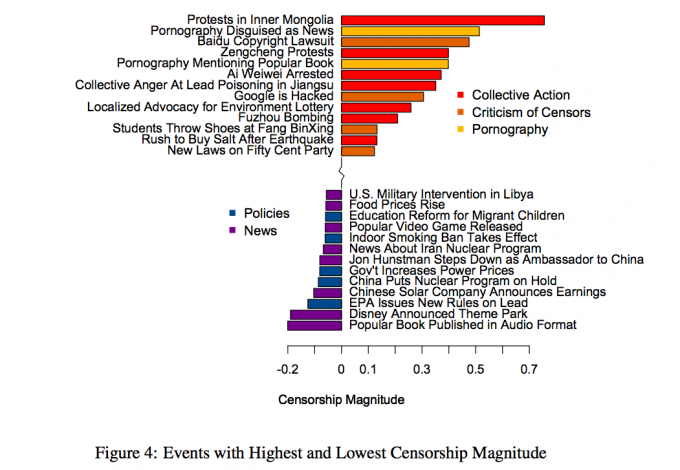
In the HIGH level category were issues and personalities such as embattled artist-critic Ai Weiwei, the blind activist who recently took refuge in the US Chen Guangcheng, dissident Liu Xiaobo, pornographic websites, the ‘princelings’ (children of former and present high officials and leaders), militant Uighur protests, protests over a herder’s death in Inner Mongolia, Taiwan weapons, and others.
In the MEDIUM category, there were some surprises: AIDS, angry youths, food prices (along with food safety and inflation in general), environment and pollution, official corruption, one-child policy, Vietnam and South China Sea, and significantly, Tibet. In the LOW category were issues such as Chinese investment in Africa, health care reform, Chinese tennis star Li Na, traffic in Beijing, and the World Cup.