
China Leads in Clean Tech and Renewable Energy中国在清洁技术和可再生能源领域领先
Two studies on clean tech and renewable energy investment and market trends came out almost simultaneously last week drawing similar conclusions about China’s place and role going forward.
Commissioned by the United National Environment Programme (UNEP), Global Trends in Renewable Energy Investment 2012 cited China as maintaining the lead in world renewable energy investment last year, slightly ahead of the US. Global investment in renewable power and fuels reached a record US$257 billion, almost double the total for 2007.
China’s investments rose 17% to US$52 billion, moderating from the hectic pace of 2009 and 2010. Investment in the US witnessed a resurgence to US$51 billion piggybacking on a 57% surge. To a large extent, the spike was due to the expiration and imminent expiration of three major government incentive programmes causing developers to rush in before the deadlines.
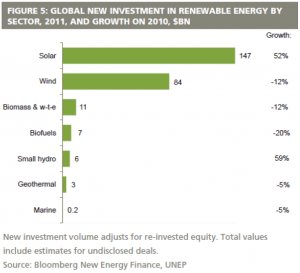
A salient aspect of renewables investment in 2011 was that solar out-paced wind as the biggest recipient sector, jumping 52% to US$147 billion. Photovoltaic (PV) module prices fell almost 50% because of manufacturing economies of scale, the rise of low-cost production in China, and over-capacity around the world. Prices plummeted to US$1-$1.20 per watt, some 76% below 2008, spurred further by increased rooftop installations in Germany and Italy and the mushrooming of small-scale PV use in China, the UK, and several other countries.
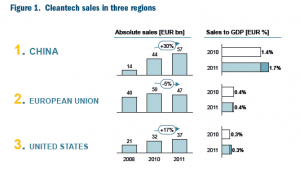
 The third edition of Clean Economy, Living Planet, commissioned by the World Wildlife Fund (WWF), named China the clear winner among the three pillar markets (EU, US, and China) for clean tech with sales growing EUR 13 billion (US$16.3 billion) to EUR 57 billion (US$71.4 billion) last year. The total value of world clean tech manufacturing reached EUR 198 billion (US$248 billion), doubling since 2008. Sales in the US also grew, but, as a share of its economy, they were significantly lower than in China and the EU.
 In absolute terms, China remains the largest clean tech country as a result of consistent government policies, strong applied R & D, and a well-developed supply chain, concluded the report. Focused on biofuels and despite the spike in investment mentioned in the UNEP report, the US still lacks government incentives for other clean tech sectors compared to the EU and China. Meanwhile in Europe, with the exception of Denmark and Germany, clean tech sales declined in the Netherlands, France, and Spain, no doubt impacted by the financial crisis. In relative terms, Denmark holds the top spot with China closing in.
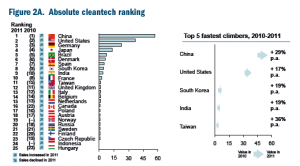
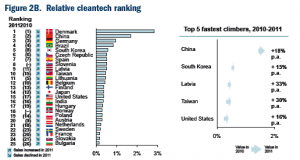
The report notes the race in clean tech manufacturing is just beginning and summarized the best practices and conditions in Denmark, China, Germany, the US, and South Korea for long-term growth: 1) government, research, and financial institutions the lay the foundations for solid industry growth; 2) markedly increasing market demand; and 3) the industry must improve efficiency and innovation and augment supply chains to optimize gains. Chinese companies enjoy good access to capital, economies of scale, and the benefits of vertical integration.
Based on company responses and analysis of regional developments, the report makes a number of recommendations for each pillar market. For China, it suggested the Chinese government allocate even more resources to basic research and to attract the best and brightest into the sector. The government should build more awareness that would help grow the sector and Chinese companies should adjust their practices to incorporate more clean tech technologies and products.
The report estimates the clean tech market will grow between EUR 40 and 90 billion (US$50.1 to $112.74 billion) by 2015 and drew base case and best case scenarios (if certain recommendations and measures are adopted) for each region. The EU could grow by EUR 19 to 31 billion (US$23.8 to $38.8 billion), the US by EUR 23 to 28 billion (US$28.8 to $35.1 billion), but China would stand to gain the most from EUR 30 to 80 billion (US$37.6 to 100.2 billion).