
Fighting Corruption in China
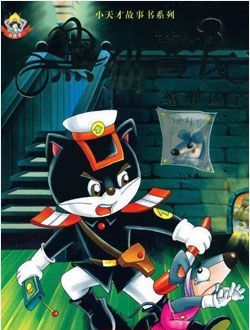
‘Heimaojingzhang’ (Captain Black Cat), a popular Chinese TV cartoon series of the 1990s and 2000s.
Anti-corruption is nothing new to China. Soon after the establishment of the PRC, Chairman Mao executed one of his closest comrades for taking what amounts to a pittance of the hauls taken in today. Mao’s crusade against officialdom rose to a crescendo during the Cultural Revolution when hundreds of thousands of officials, mostly unjustly, were sent down to factory floors and the countryside for re-education by worker-peasants.
China’s economic reforms, particularly since the 1990s, have ushered an era of escalating corruption unseen in previous decades, forcing the authorities to introduce a plethora of laws and launching innumerable campaigns to combat the blight. Since the early 2000s, disciplinary authorities of the Communist Party of China (CPC) have issued all sorts of decrees, codes of conduct, and asset disclosure requirements for its officials and their families.
The central government had also made plans to introduce ‘sunshine’ legislation, some modeled after US precedents, for senior cadre to publicize their wealth, encouraging local authorities to do the same, albeit to limited effect. The most impressive policies for disclosure were passed in Baimiao Township of Bazhong City, Sichuan Province in 2010. There, government revenues and expenditures as well as the salaries and benefits of incumbent and retired officials were fully disclosed on local government websites.
However, resistance to anti-corruption measures remains strong in a country where whistle-blowing goes against the grain of tradition. ‘Sunshine’ policies expose the system’s underbelly and ‘qianguize’ (hidden rules) that prevail among officialdom and business circles perpetuating opaque governance and facilitating corrupt practices. In Baimiao, for instance, after the disclosure policies were announced, government operations were virtually boycotted by higher-level authorities with city departments reluctant to help out with Baimiao’s infrastructure projects.
In the late 1990s, the hard-nosed and incorruptible Premier Zhu Rongji cracked down hard on high-profile corruption cases leading, among others, to the arrest warrant for Mr Lai Changxing, the mastermind of the multi-billion dollar Xiamen (Fujian Province) smuggling ring that implicated hundreds of central and provincial officials. Mr Lai managed to escape to Canada where he languished for over a decade in the Canadian court system, eventually exhausting his legal avenues and being extradited back to China where he is currently facing formal sentencing.
Despite repeated calls by President Hu Jintao and Premier Wen Jiabao to intensify anti-corruption efforts and improve intra-Party supervision, not to mention the establishment of an anti-corruption database and network, China’s anti-corruption record has fallen far short of rhetoric. In addition to the lack of an independent judiciary and a free press, there is no truly autonomous anti-graft agency along the lines of Hong Kong’s Independent Commission Against Corruption (ICAC).
“The Communist Party can mobilize human and financial resources to (suppress corruption)”, explained Liao Ran, the new Program Officer for China and South Asia at Transparency International to the New York Times last year. At the same time, because government officials are involved, even though corruption is very serious, it is ‘under control’, he added paradoxically. In 2010, the CPC’s Central Commission for Discipline Inspection, the Party’s anti-corruption arm, investigated nearly 140,000 cases of malfeasance, punishing over 146,000 persons, of which 5,373 cases have been referred to the courts for criminal prosecution.
The advent of the Internet and blogging in China has at times helped the fight against corruption. In the past few years, for good or bad, the phenomenon of ‘human flesh search engines’, operated by online sleuths and vigilantes, have tracked suspected wrongdoers, using databases, search engines, photo and video analysis, social networking sites, and even blatant hacking. Most damaging has been the online postings of video and photos exposing the abuses of corrupt officials and businessmen.
Last year, public relations consultant Chen Hong launched a website, www.ibribery.com, that allowed netizens to anonymously post their experiences with bribe-taking officials. The site drew 200,000 visitors within two weeks of its launching but censors shut down access to the site for people inside China soon after. Other netizens have set up copycat sites such as www.522phone.com and www.wohuixingle.info, vowing to carry on the fight. Last reported, Mr Chen was applying for a license to operate on the mainland and working with others to improve the site while it is offline. (Current status of application is not known.)
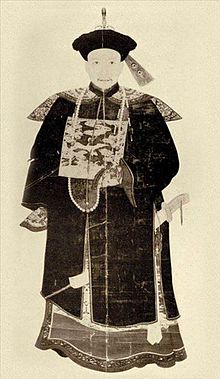
The infamous He Sen (1750-1799), Minister of the Treasury and Prime Minister in the court of Qing Emperor Qianlong who amassed 800 million taels of silver, equivalent to 10 years of government revenue. After his arrest, the Emperor sentenced him to death by self-hanging.
Corruption has a long dynastic legacy in China and one need only review the chronicles of the Qing Dynasty and earlier empires to see the complex system of interests that contributed to the disease. But, one aspect of traditional Chinese governance adds directly to its perpetuation and growth – the Confucianist preference for ‘renzhi’ (governance by virtuous officials) over the rule of law (as initially codified by the Legalist School) that puts weight on fostering the moral integrity of officials while repudiating wealth-seeking. Whereas moral righteousness is an ideal principle, it fails to stem corruption in the real world of government and business.
In many ways, the CPC carries on this tradition. Despite the proliferation of rules and regulations and laws against corruption, the CPC persists in putting priority on government by trusted officials over the institutionalization of safeguards and systems of punishment. Its focus on the cultivation of honorable officials is quintessentially Confucianist.